Where are care homes closing or converting?
Which care homes are applying to change to houses, flats or shared housing, where, and what does that mean for the homes left?
Loss of care use applications show homes leaving the market before CQC records them closed. They point to districts where small, older homes no longer pay, to beds that will need replacing, and sometimes to owners ready to sell to another operator rather than convert.
When people use it: When looking for homes to buy or sites to convert, and each quarter when watching a market.
How it works, step by step
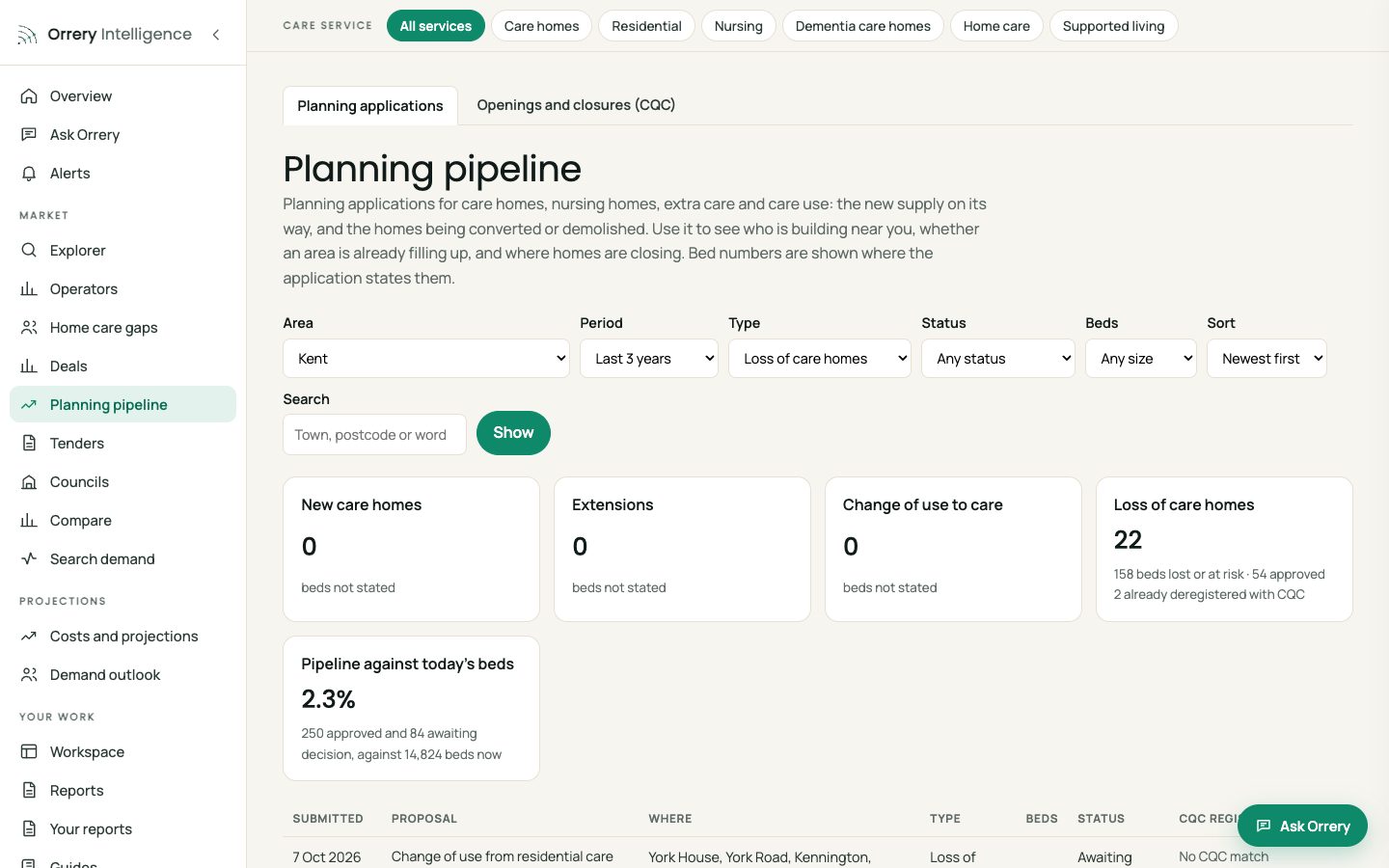
Homes being lost in the council
Every application to change a care home or nursing home to another use, with district, status and the proposed use: a house, flats, or a house in multiple occupation.
What is still undecided
Applications awaiting a decision. The home may still be trading, and an approach before permission is granted can sometimes buy it as a going concern.
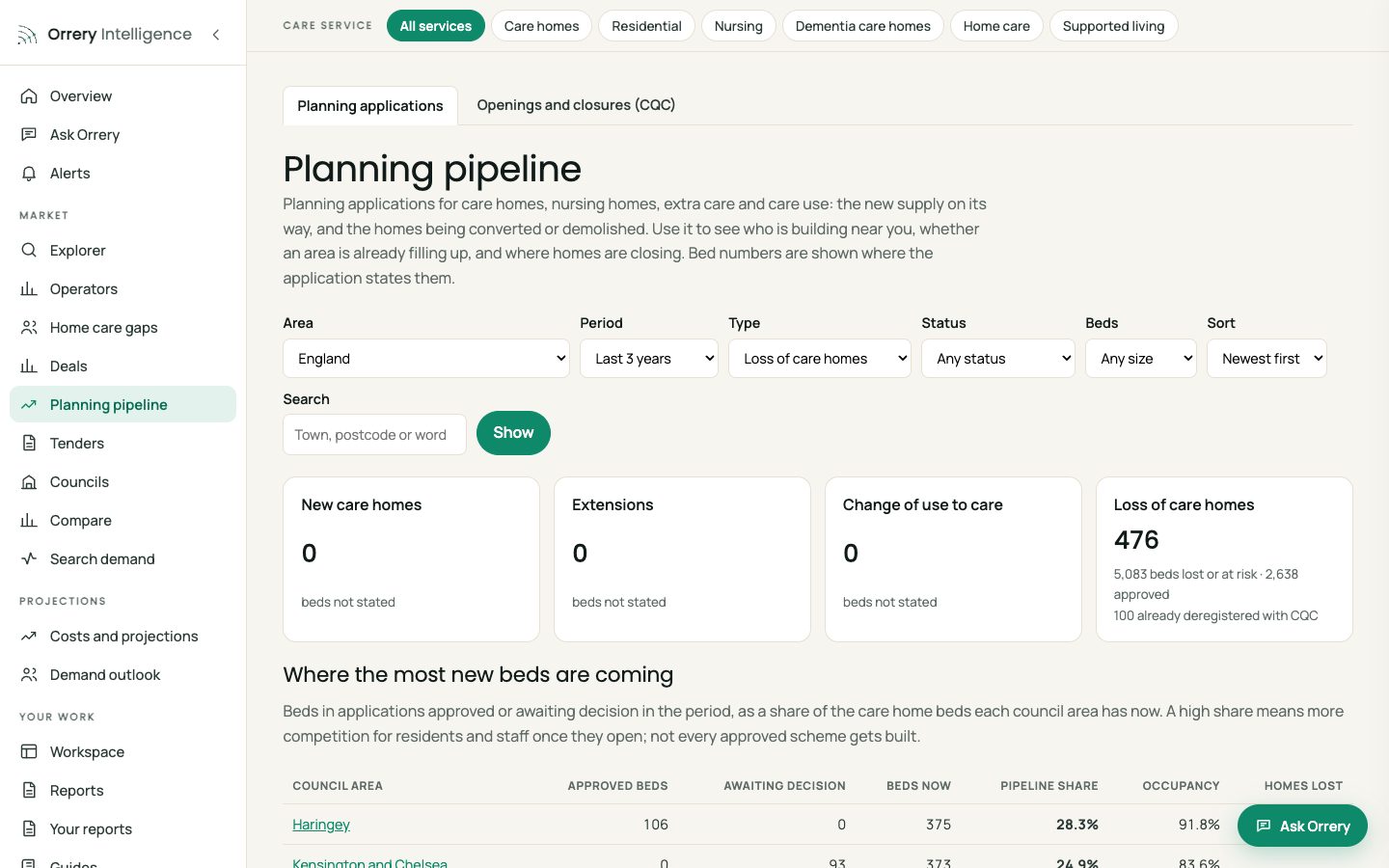
Compare councils
Leave the area blank to see England. Councils with many losses and few new homes are where supply is thinning.
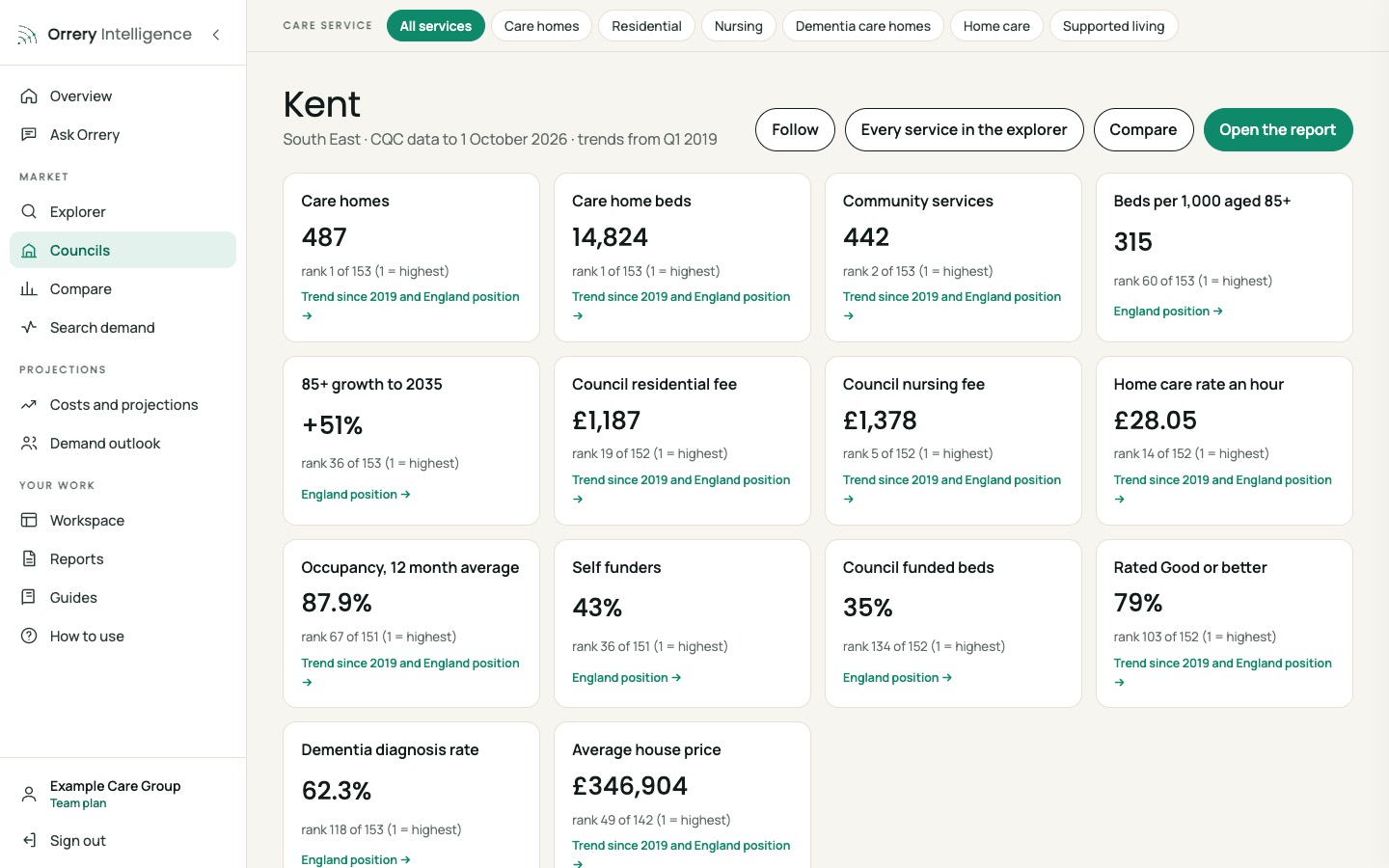
Why homes are closing
Occupancy, fees, the share of small homes and the council risk score on the dashboard explain whether losses come from weak demand or from homes that cannot meet the modern standard.
Who is left nearby
Use Near postcode for the homes around a closure: they will take its residents and its staff.
The views you will use
Ask the data in plain English
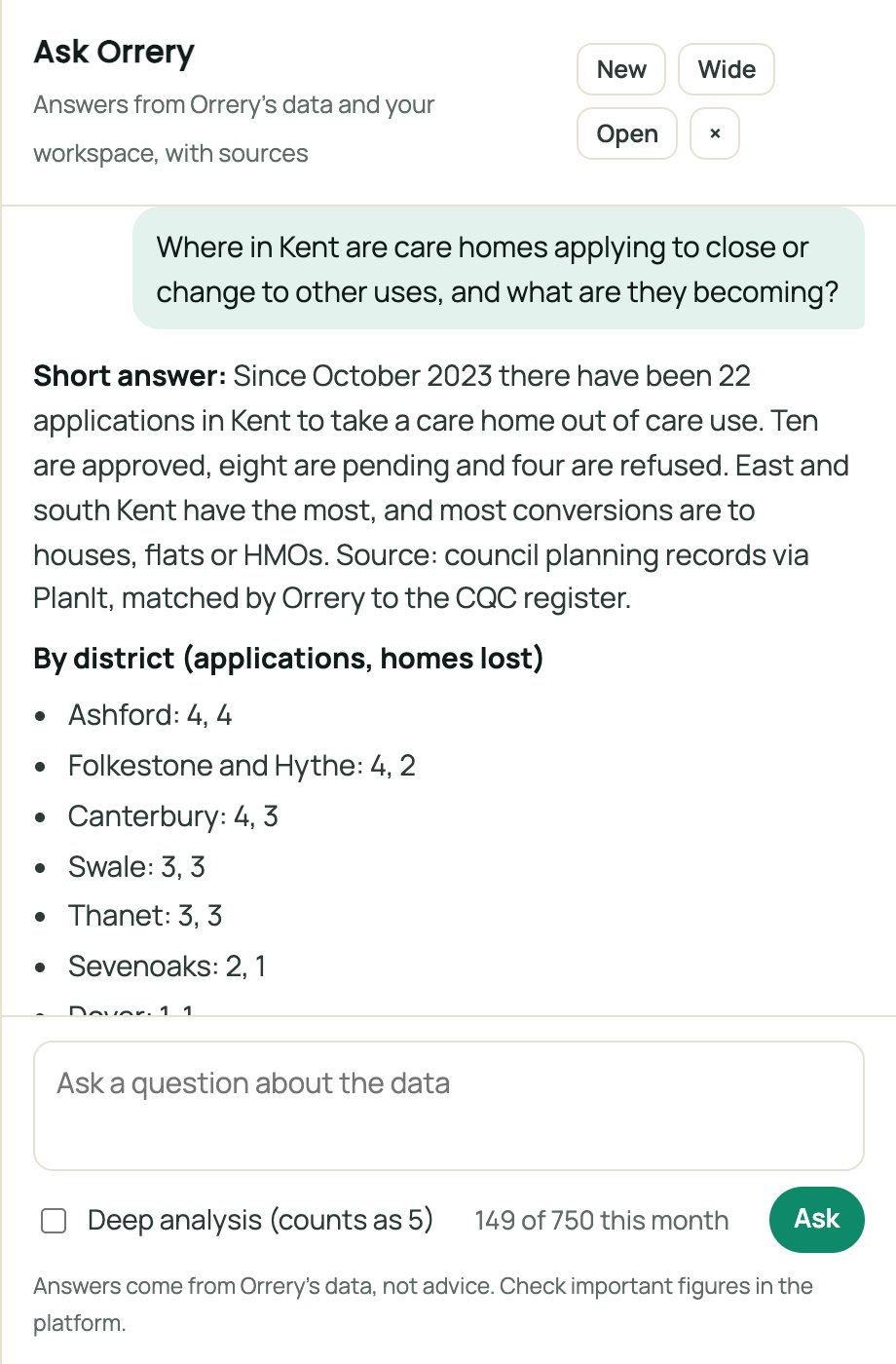
A real question and answer from Ask Orrery, the assistant inside the platform, for a care home owner in Kent (October 2026). It answers only from Orrery's data and the subscriber's own documents, and shows its sources.
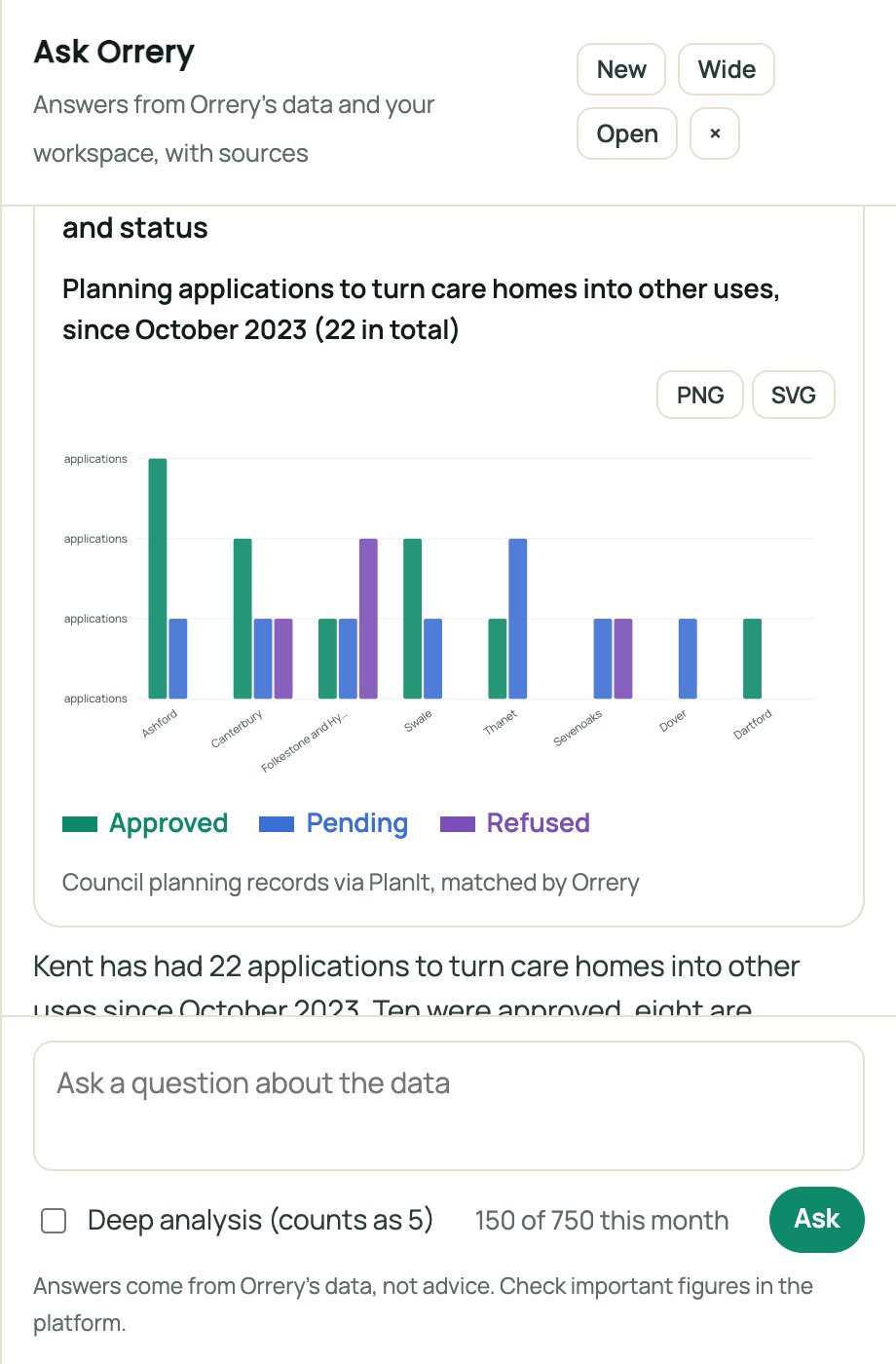
Short answer: Since October 2023 there have been 22 applications in Kent to take a care home out of care use. Ten are approved, eight are pending and four are refused. East and south Kent have the most, and most conversions are to houses, flats or HMOs. Source: council planning records via PlanIt, matched by Orrery to the CQC register.
By district (applications, homes lost)
- Ashford: 4, 4
- Folkestone and Hythe: 4, 2
- Canterbury: 4, 3
- Swale: 3, 3
- Thanet: 3, 3
- Sevenoaks: 2, 1
- Dover: 1, 1
- Dartford: 1, 1
What they are becoming
- Single houses (C3): Ashford (TN24, TN25), Folkestone and Hythe (CT20), Canterbury (CT6), Swale (ME12) and Dartford (DA13). Most of these are approved.
- Flats: a Folkestone and Hythe scheme for 12 flats (TN29, pending), a Dover scheme for 9 flats (CT17, pending), and an 8-dwelling scheme at Ocean Heights Residential Home in Swale (pending). Sevenoaks refused a demolition and 8-flat scheme (TN13).
- HMOs: Blackburn Lodge in Swale (12 rooms, approved, already closed). Thanet has two pending: Green Gables (13-bed HMO, CT9) and a 21-bed HMO (CT10). An Ashford nursing home became staff accommodation (approved). Folkestone and Hythe refused a 23-room HMO.
- Smaller dwellings: Footprints in Canterbury (4 dwellings, approved on a second application after a refusal) and a Thanet home becoming two 5-bed houses (approved).
Still trading? Ocean Heights (50 beds), Green Gables (18), Carlile Lodge (10) and Footprints (10) are still on the CQC register. Stanholm (26 beds) and Blackburn Lodge (34) have closed. In total, 148 beds sit in the homes being lost, and 2 of these homes have already deregistered.
What it means: Losses are concentrated in small homes on the coast and in the east. For an owner, pending applications show where local supply may thin. Check CQC registration before approaching anyone, because an application is a signal and not a closure date. Beds are rarely stated, so count homes rather than beds.
Open in Orrery: /app/pipeline?area=kent&cat=loss_of_care_use&months=36 Guide: /app/guides/pipeline-homes-closing?council=kent
I can chart this by district or list the pending applications only.
More questions you can ask
- “Which councils in England have the most care home loss of care use applications in the last three years, and how do they compare with new care home beds approved?”
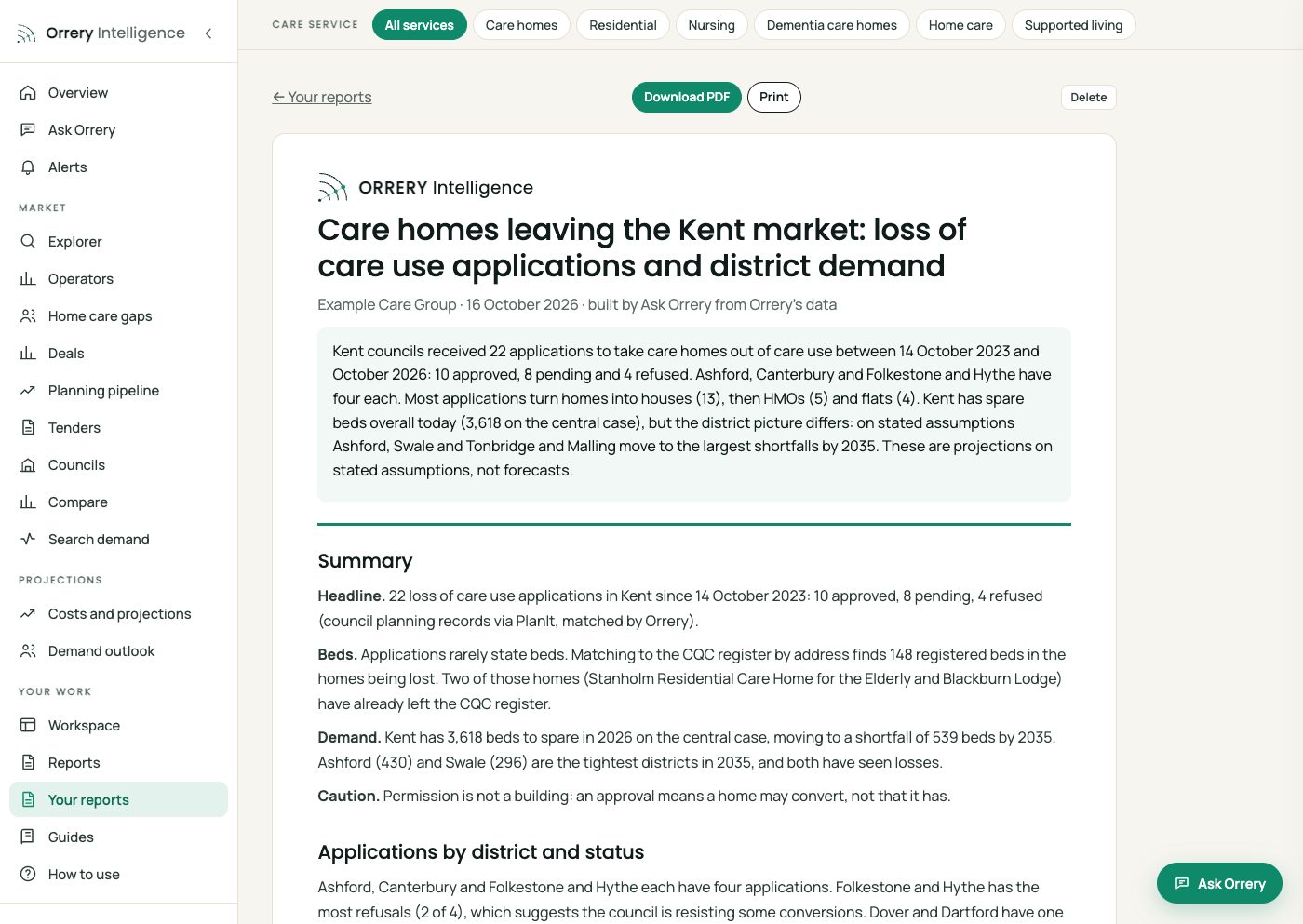
- “Build a two page report on care homes leaving the Kent market: loss of care use applications by district and status, what they are becoming, and the district demand outlook, with a table.”
Ask, chart and report, in plain English
Ask Orrery answers from Orrery's data, draws charts on request and builds reports you can save as PDF. These are real examples for Kent.
- A loss of care use application is a strong signal, not a closure date. Some are for homes that closed long ago; check CQC registration before contacting anyone.
- Most losses are small homes becoming houses. Beds are rarely stated, so count homes rather than beds.
Answer this for your own councils
Subscribers get every guide, chart and projection for all 153 councils, Ask Orrery with private uploads of their own files, and every council report.
See plans