Finding gaps in home care coverage
Where do older people live with too few home care agencies nearby, and where is the best place to open or expand?
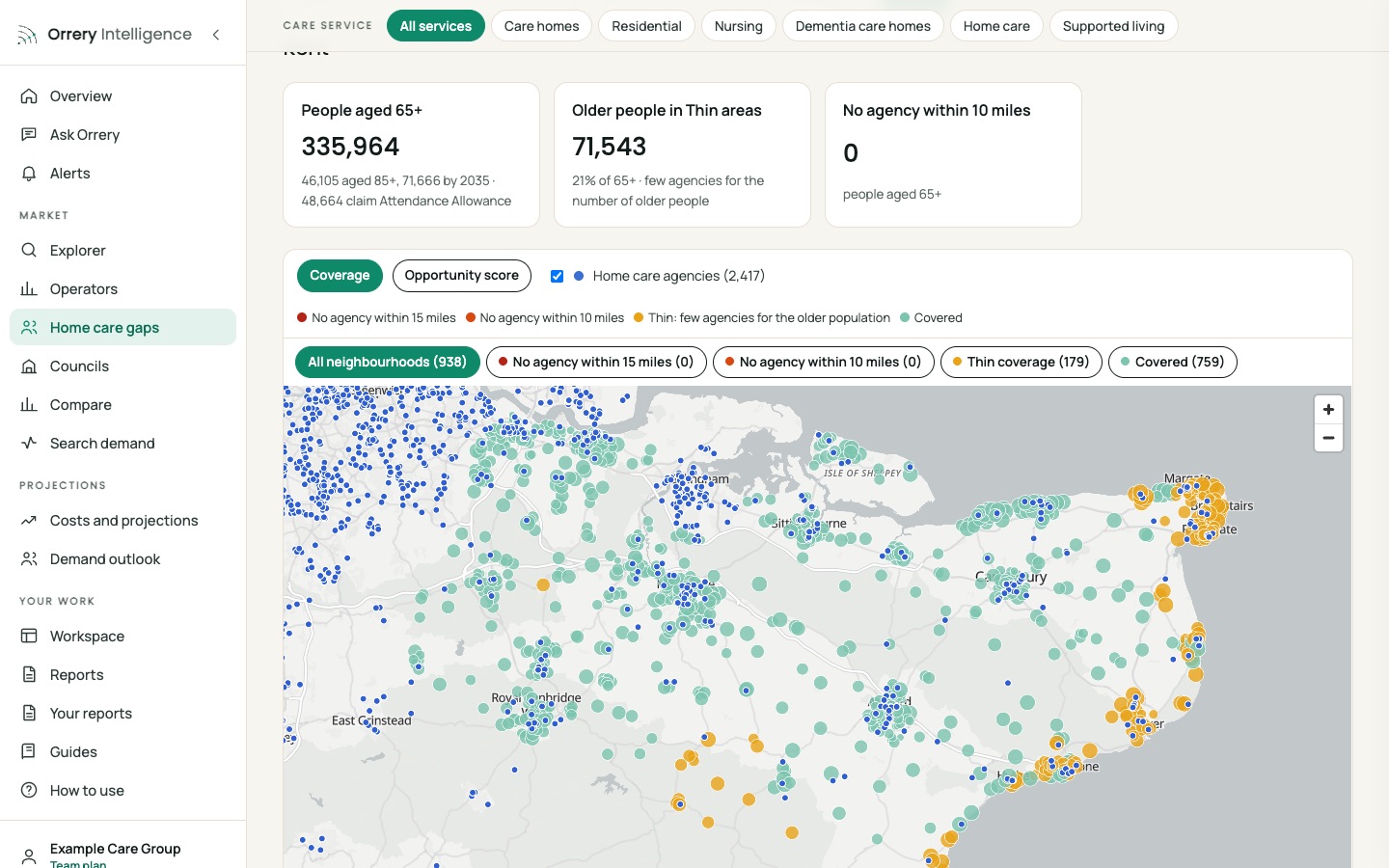
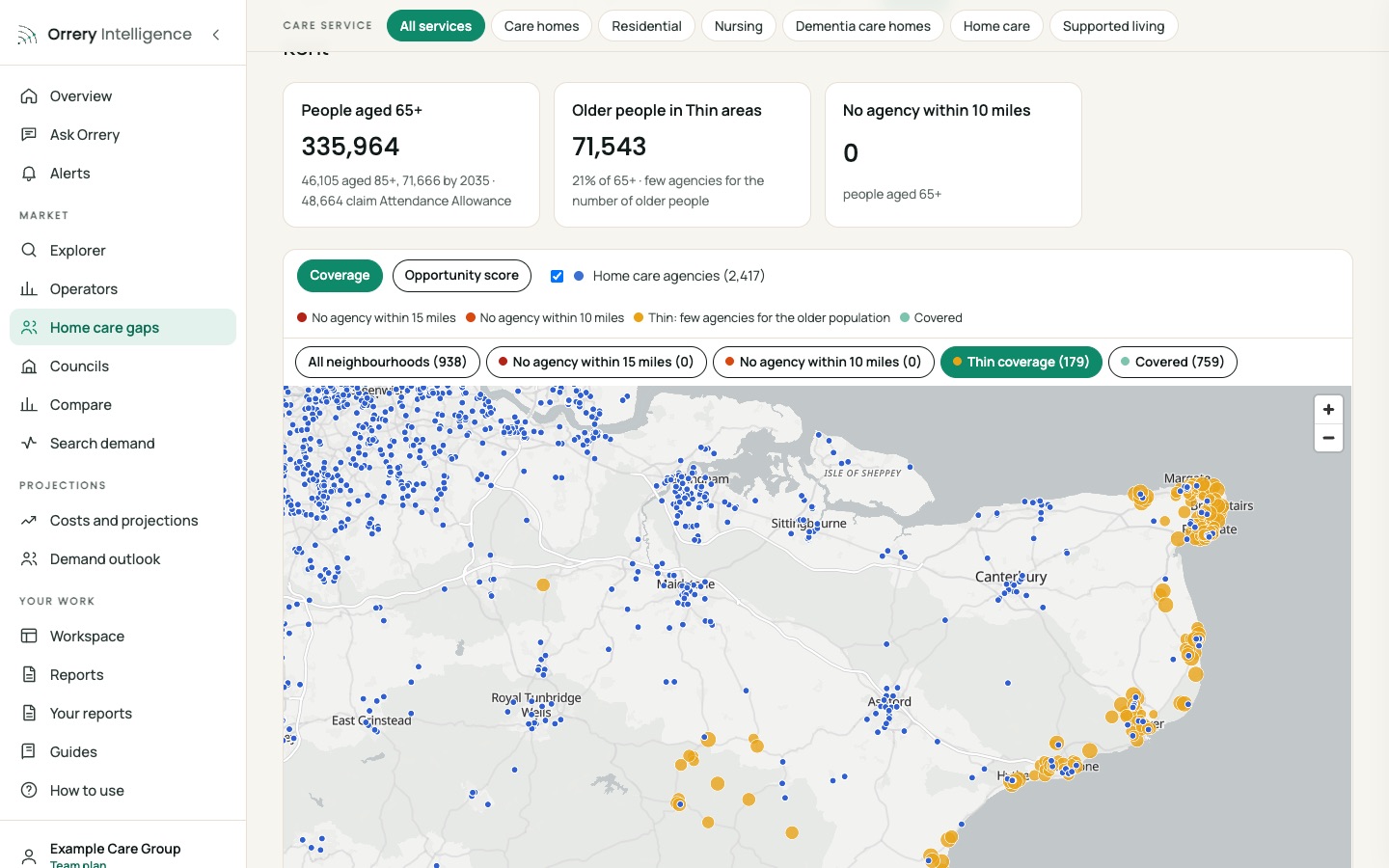
Every neighbourhood in England is checked against the home care agencies registered for older people within 5, 10 and 15 miles. Filter to areas with no agency within 10 or 15 miles or thin coverage, see the older population, growth to 2035, Attendance Allowance claimants and search intent for each, and rank the best places to open.
When people use it: Before choosing where to open a branch, extend your area, recruit, or spend on advertising.
How it works, step by step
The coverage map for your council
Each dot is a neighbourhood of about 1,500 people, sized by people aged 65+ and coloured by coverage. Blue dots are agencies. Use the buttons to show only neighbourhoods with no agency within 15 miles, within 10 miles, or with thin coverage, with a list of them underneath.
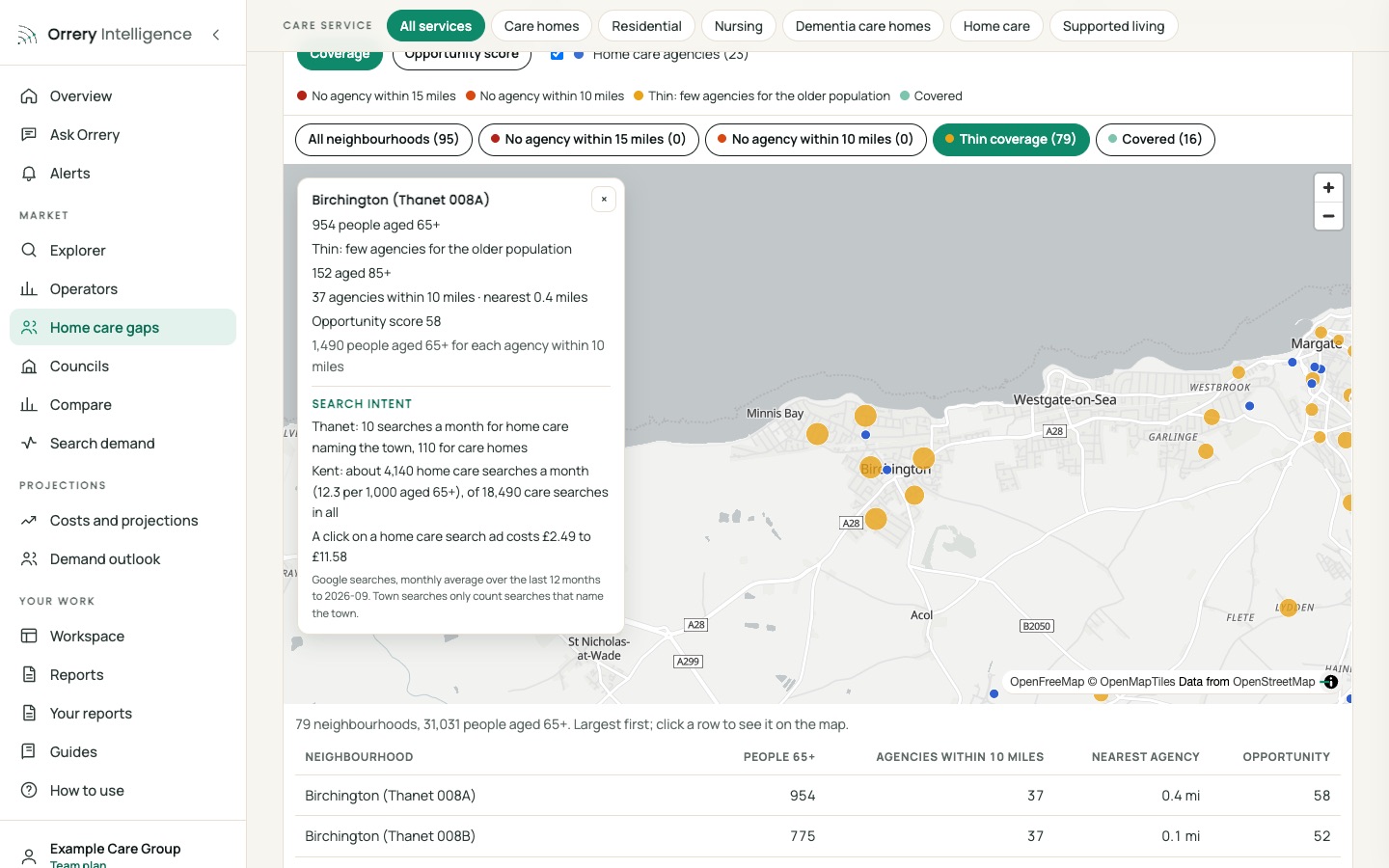
Click a neighbourhood
See its older population now and the 85+ population, agencies within 10 miles and the nearest one, the opportunity score and why. Search intent: searches for home care naming the town, home care searches across the council per 1,000 aged 65+, and the cost of a click.
Check around your office
Enter your office postcode and a radius of 5, 10, 15 or 20 miles: the older people, the agencies you compete with, and the best areas nearby.
Best places to open or expand
The opportunity score weighs under supply, older people and growth to 2035, ability to pay privately and search demand. Very sparse areas are marked down because visit runs there rarely pay.
Who you would compete with
Use Near postcode in the explorer for each agency's rating, size and owner, and the operator league for the groups behind them.
What it would pay
The council's hourly rate, private rates agencies publish in your region, and the council risk index before taking council work.
The views you will use
Ask the data in plain English
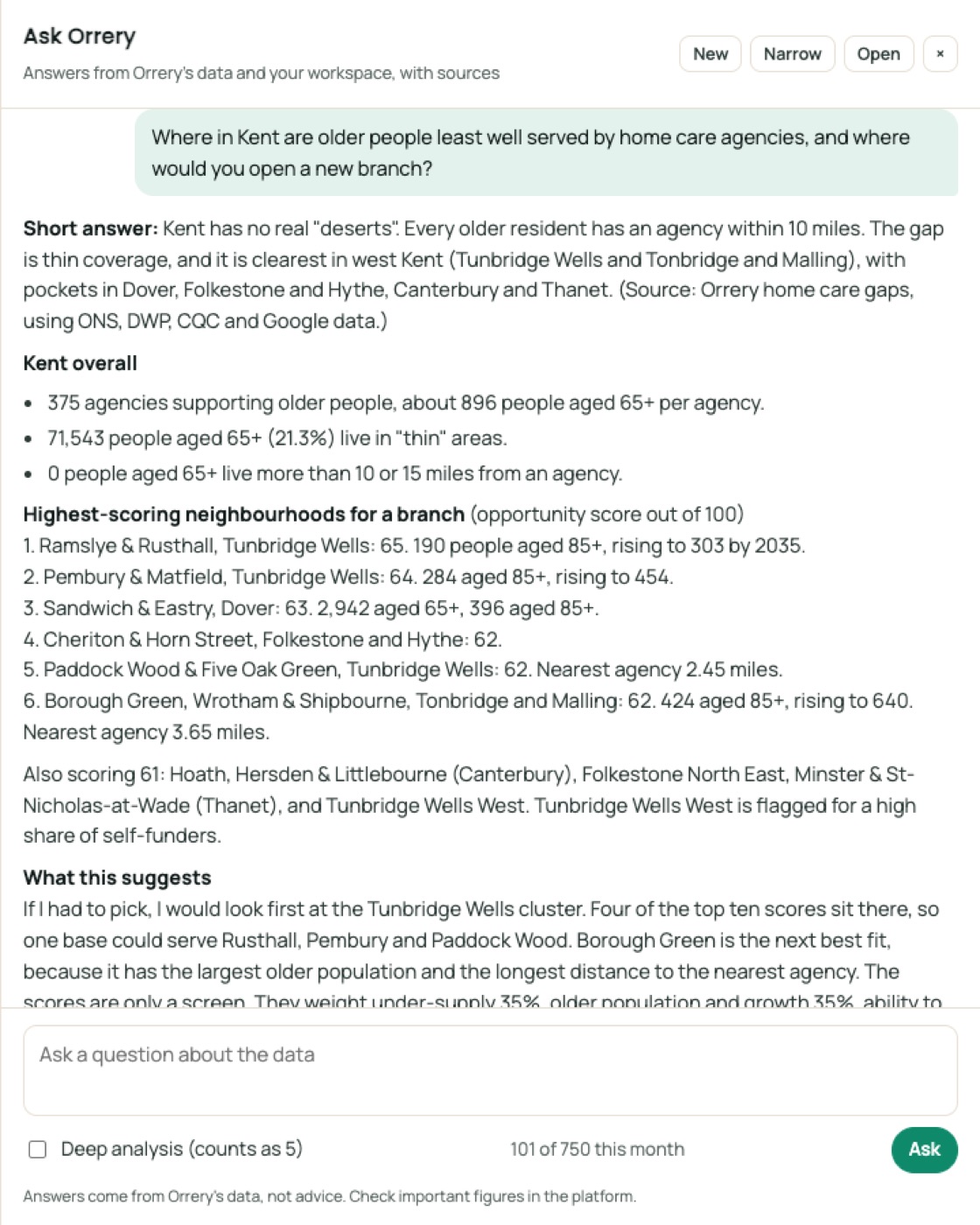
A real question and answer from Ask Orrery, the assistant inside the platform, for a care home owner in Kent (October 2026). It answers only from Orrery's data and the subscriber's own documents, and shows its sources.
Answer: Kent has no neighbourhood without an agency within 10 or 15 miles. The gap is thinness: about 71,500 people aged 65+ (21.3%) live in "thin" areas. The best-scoring places to open are in Tunbridge Wells, Dover, Folkestone and Hythe, Tonbridge and Malling, Canterbury and Thanet. I've assumed you mean home care for older people.
Highest-scoring neighbourhoods (Orrery opportunity score, 0 to 100):
- Ramslye & Rusthall, Tunbridge Wells: 65
- Pembury & Matfield, Tunbridge Wells: 64
- Sandwich & Eastry, Dover: 63. It has 2,942 people aged 65+ and 396 aged 85+.
- Cheriton & Horn Street, Folkestone and Hythe: 62
- Paddock Wood & Five Oak Green, Tunbridge Wells: 62
- Borough Green, Wrotham & Shipbourne, Tonbridge and Malling: 62. It has 424 people aged 85+ now, rising to 640 by 2035, and the nearest agency is 3.65 miles away.
Tunbridge Wells West (61) scores well partly because many residents pay for their own care.
Supply by district: Tunbridge Wells (21 services), Sevenoaks (21) and Folkestone and Hythe (19) have the fewest home care services. Dartford (68) and Maidstone (54) have the most. These counts cover all home care services and are not adjusted for population.
What this means: Tunbridge Wells and the Borough Green area show up repeatedly. They combine fewer agencies than average, a fast-growing 85+ population and an ability to pay privately. Folkestone and Hythe is better for council-funded work, with nearer agencies but a thin market.
Limits:
- The score weights under-supply 35%, older people and growth 35%, private pay 20% and search demand 10%.
- Distances are straight lines from CQC registered offices.
- It's a screening tool, not a decision. Check local recruitment, travel times and competitors, and take professional advice.
There is also a guide, "Finding gaps in home care coverage". Would you like me to open it for Kent?
Sources: Orrery home care gaps (ONS, DWP Attendance Allowance, CQC, Google search data) and the CQC care directory, 1 October 2026.
Ask, chart and report, in plain English
Ask Orrery answers from Orrery's data, draws charts on request and builds reports you can save as PDF. These are real examples for Kent.
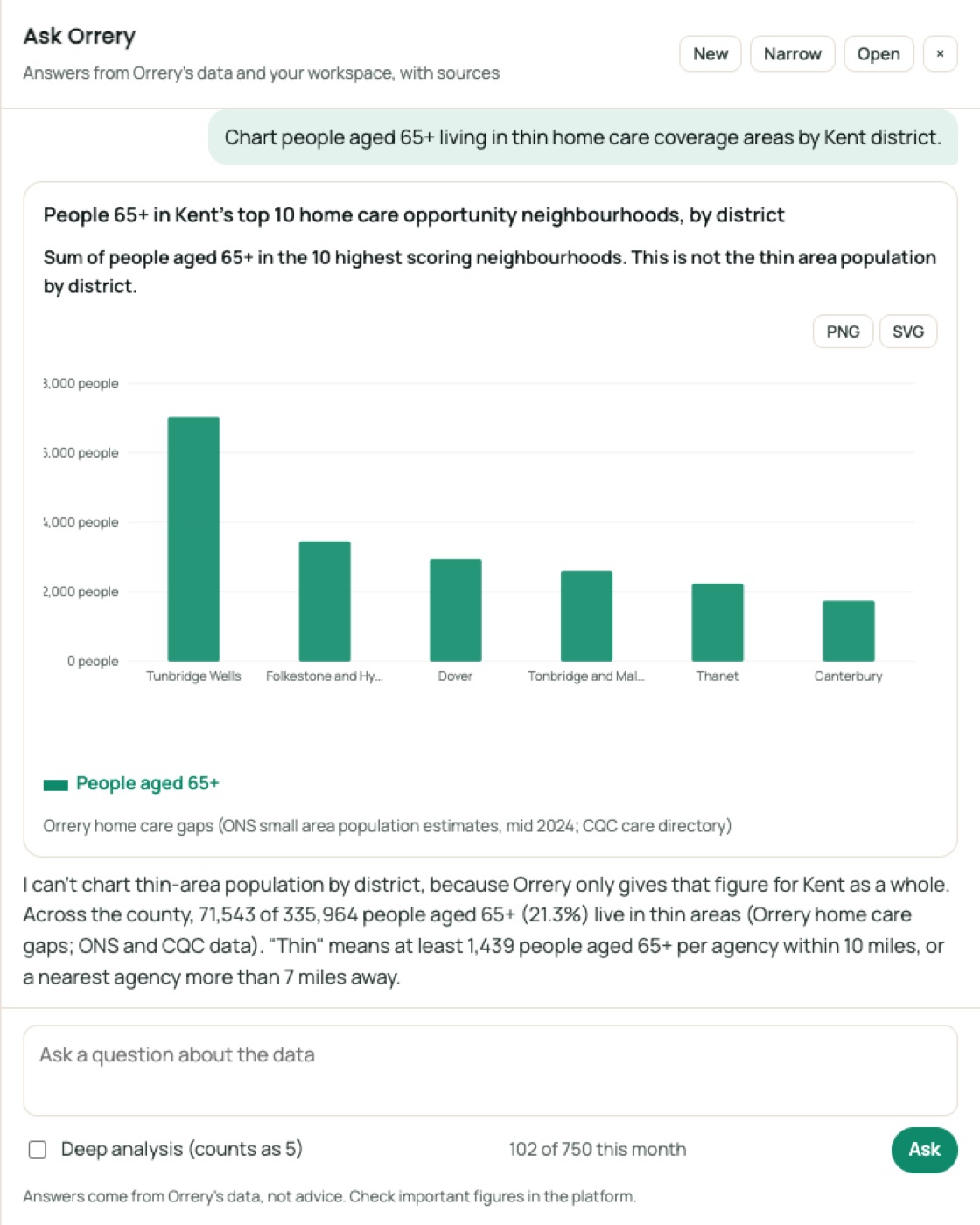
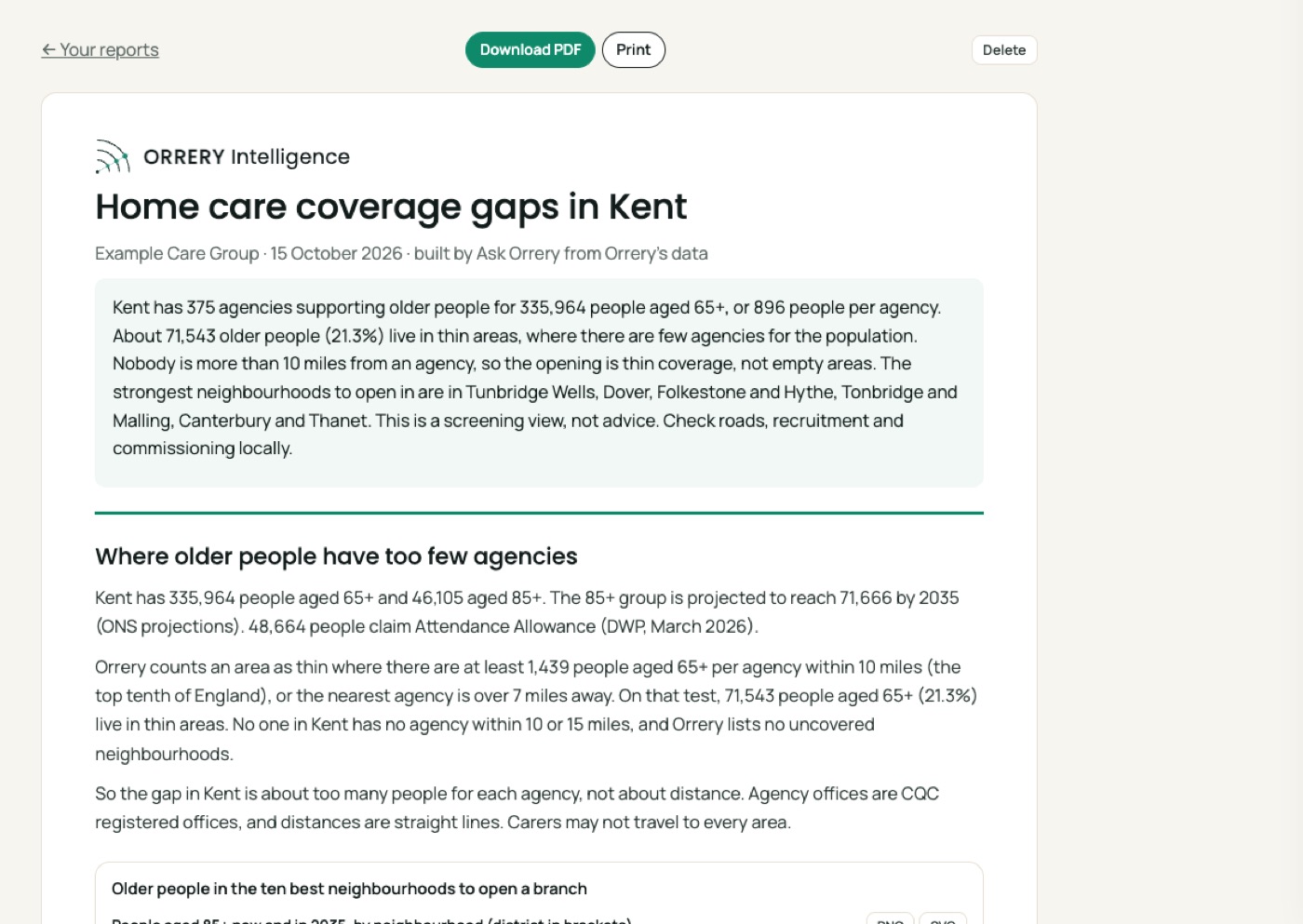
- Very few places in England are more than 15 miles from an agency office; the larger opportunity is thin coverage, where there are many older people for each agency.
- CQC registers an agency's office, not where carers travel, and distances are straight lines: check roads, recruitment and local commissioning before deciding.
Answer this for your own councils
Subscribers get every guide, chart and projection for all 153 councils, Ask Orrery with private uploads of their own files, and every council report.
The Orrery platform opens to subscribers shortly. Register and we will tell you first.
Register for early access