Should we build a new care home here, and where?
Is there enough unmet need in this council, and which district has the clearest case?
Start from need against beds to 2035, narrow to the districts that run short, then check occupancy, fees and the competition before you choose a site.
When people use it: Before buying land or committing to a site, and again before planning.
How it works, step by step
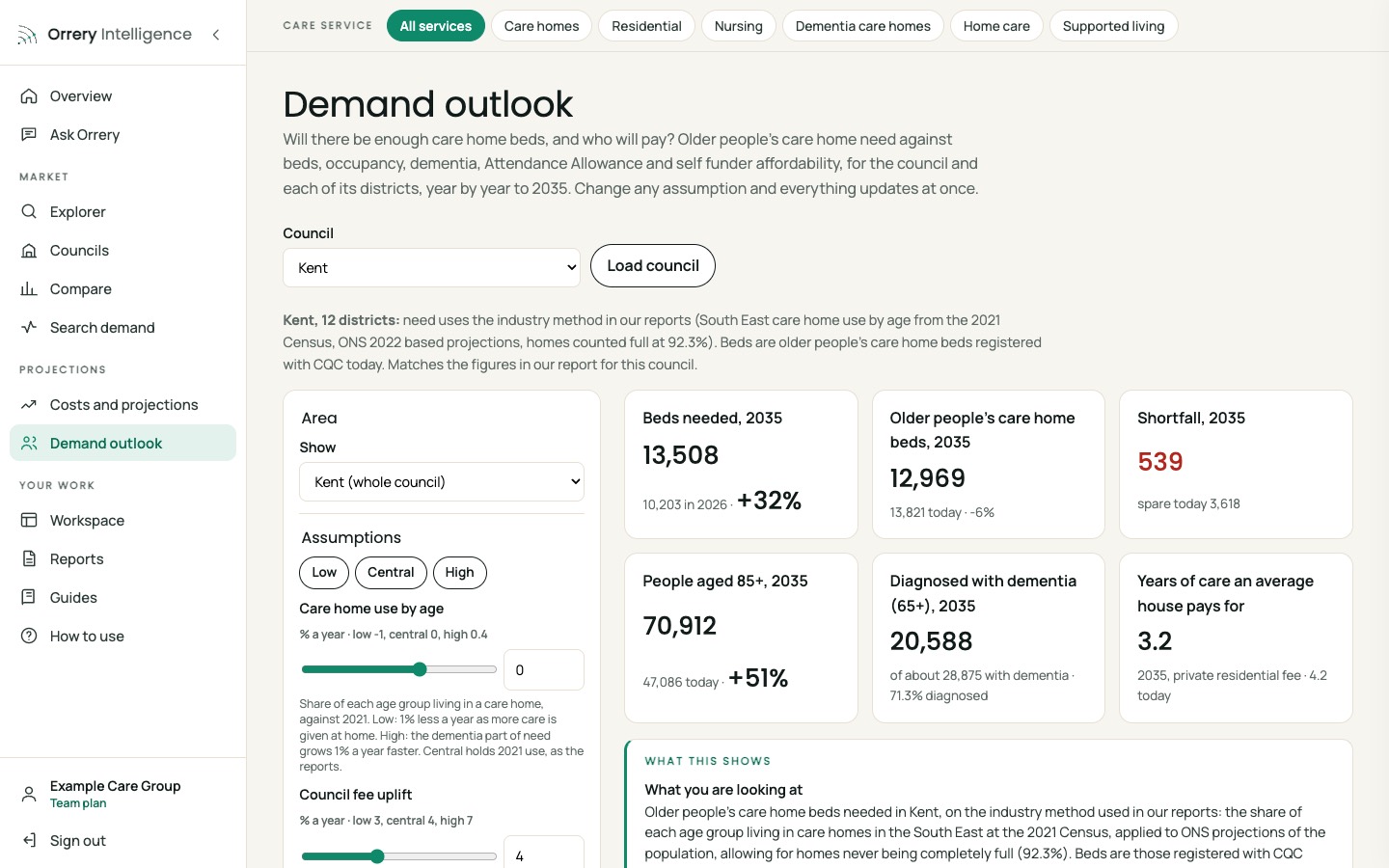
Need against beds to 2035
When does beds needed overtake beds? The year the lines cross is when a new home stops competing for residents and starts meeting unmet need. Switch the care service bar to Residential, Nursing or Dementia: the case is often strongest for one of them. Try the low case (more care at home, more beds opening) to see whether the case survives a pessimistic view.
Choose the district
In Districts compared, pick 2030 and 2035. A council with room overall can still have districts that are short. Click the shortest district: the whole page switches to it.
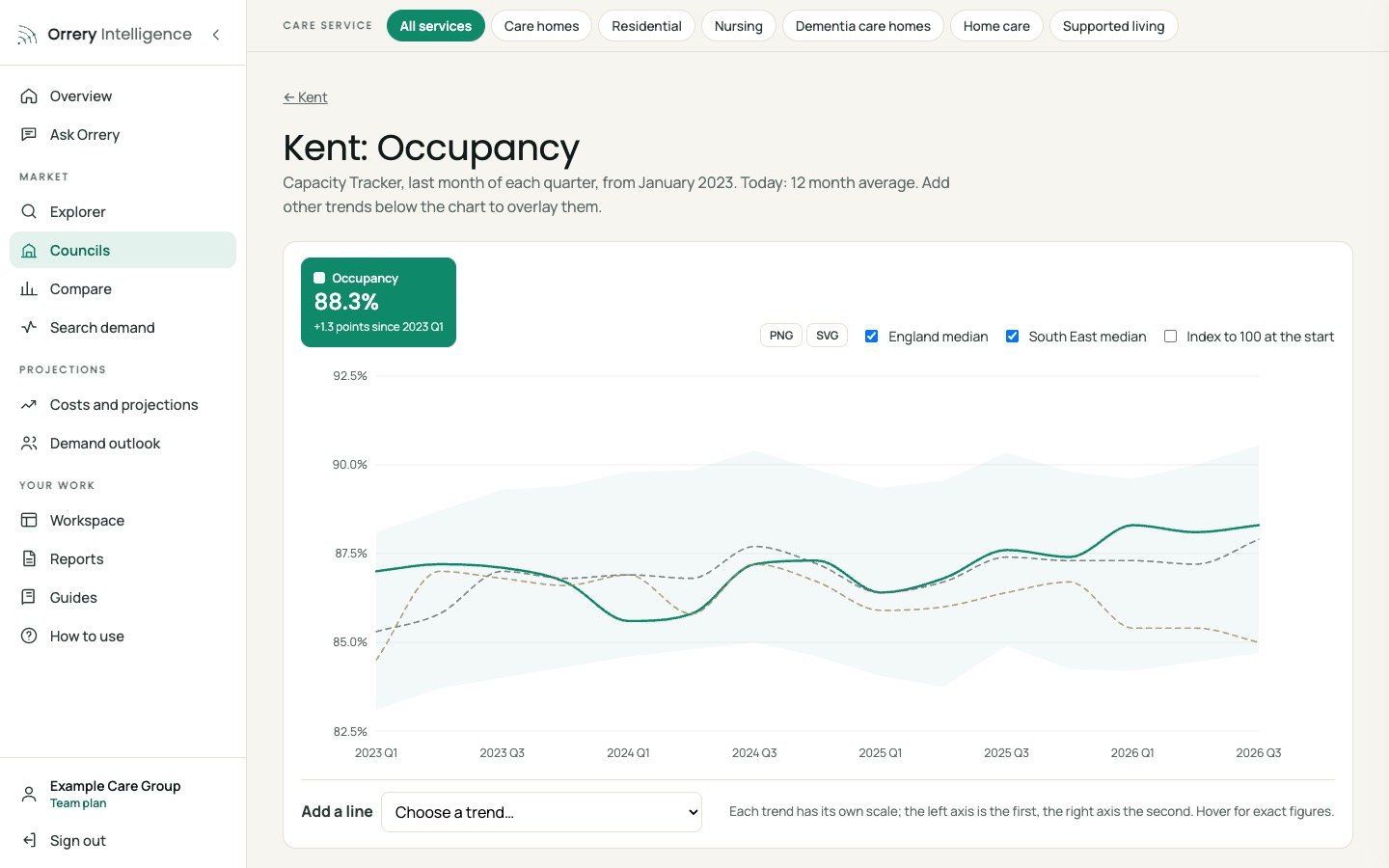
How full are homes today?
Above about 88% and rising supports a new home; below 85% means you will be filling against spare capacity. Check before and after COVID: has occupancy recovered?
Supply trend and the 85+ population
Beds flat or falling while the 85+ population grows is a tightening market. Registrations and deregistrations show how much new supply has actually arrived.
Who you would compete with
Sort by newest: homes registered since 2012 are your real competition for self funders. Filter by district and rating; save the search to your workspace.
Will it pay?
Set your planned beds, fees and occupancy. Check the margin in the high costs case and in your first year at lower occupancy.
The views you will use
Ask the data in plain English
A real question and answer from Ask Orrery, the assistant inside the platform, for a care home owner in Kent (October 2026). It answers only from Orrery's data and the subscriber's own documents, and shows its sources.
Ashford has the clearest case by 2030. This is on Orrery's central assumptions, which are projections, not forecasts.
- 2030: Ashford is projected to be 147 beds short. That is the largest 2030 gap of Kent's 12 districts. Tonbridge and Malling (99) and Swale (90) follow.
- Now: Ashford has 63 beds to spare in 2026, so a new home opening today would compete for residents. The gap opens during the decade.
- 2035: The shortfall grows to 430 beds, again the largest in Kent.
- Gravesham: It is the only district already short in 2026 (37 beds), but its 2030 gap of 71 is smaller.
Kent as a whole still has spare beds in 2030. Districts differ widely, so the district figures matter more than the county total.
Source: Orrery demand outlook, using ONS projections and the CQC care directory. You can change the assumptions on the page.
Please take professional advice before committing to a site.
- A shortfall that opens after your home would open is a risk; one that already exists is a market you can fill from day one.
- District shortfalls matter more than county totals: families rarely move far.
Answer this for your own councils
Subscribers get every guide, chart and projection for all 153 councils, Ask Orrery, and every council report.
The Orrery platform opens to subscribers shortly. Register and we will tell you first.
Register for early access