Bank or lender pack from your accounts
How do our accounts and covenants look to a lender, and what does the local market say about the years ahead?
Upload accounts and occupancy. Ask Orrery works out EBITDA, interest cover and loan to value against your covenants, tests a downside, and adds the market evidence a lender looks for.
When people use it: Before a loan application, refinance or annual covenant review.
How it works, step by step
Upload accounts and occupancy
Accounts as PDF are read page by page; spreadsheets are read as tables.
Covenants and headroom
Headroom is what lenders look at: how far income can fall before a breach.
The market a lender checks
Occupancy through COVID, fee record and demand to 2035.
What you upload
- Statutory or management accounts (PDF or spreadsheet)
- Occupancy by month
Files are stored privately for your account, never shared with anyone and never used to train AI. You can delete them at any time. Spreadsheets, CSV, PDF and Word files all work, in your own layout.
Try it with sample files
Made up files for a made up provider, Example Care Group, so you can see what Ask Orrery does with them.
Questions you can ask
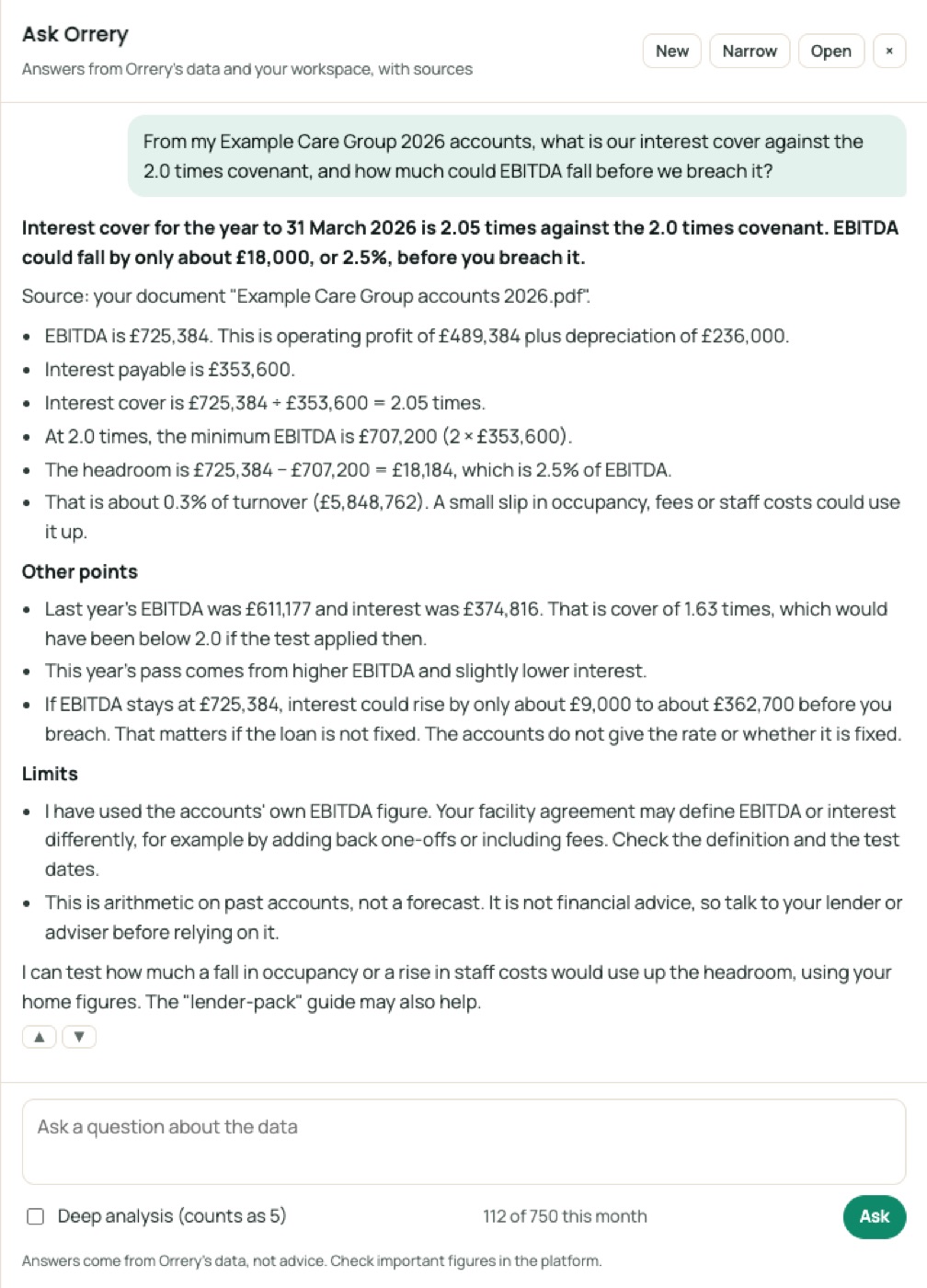
- “From my Example Care Group 2026 accounts, what is our interest cover against the 2.0 times covenant, and how much could EBITDA fall before we breach it?”
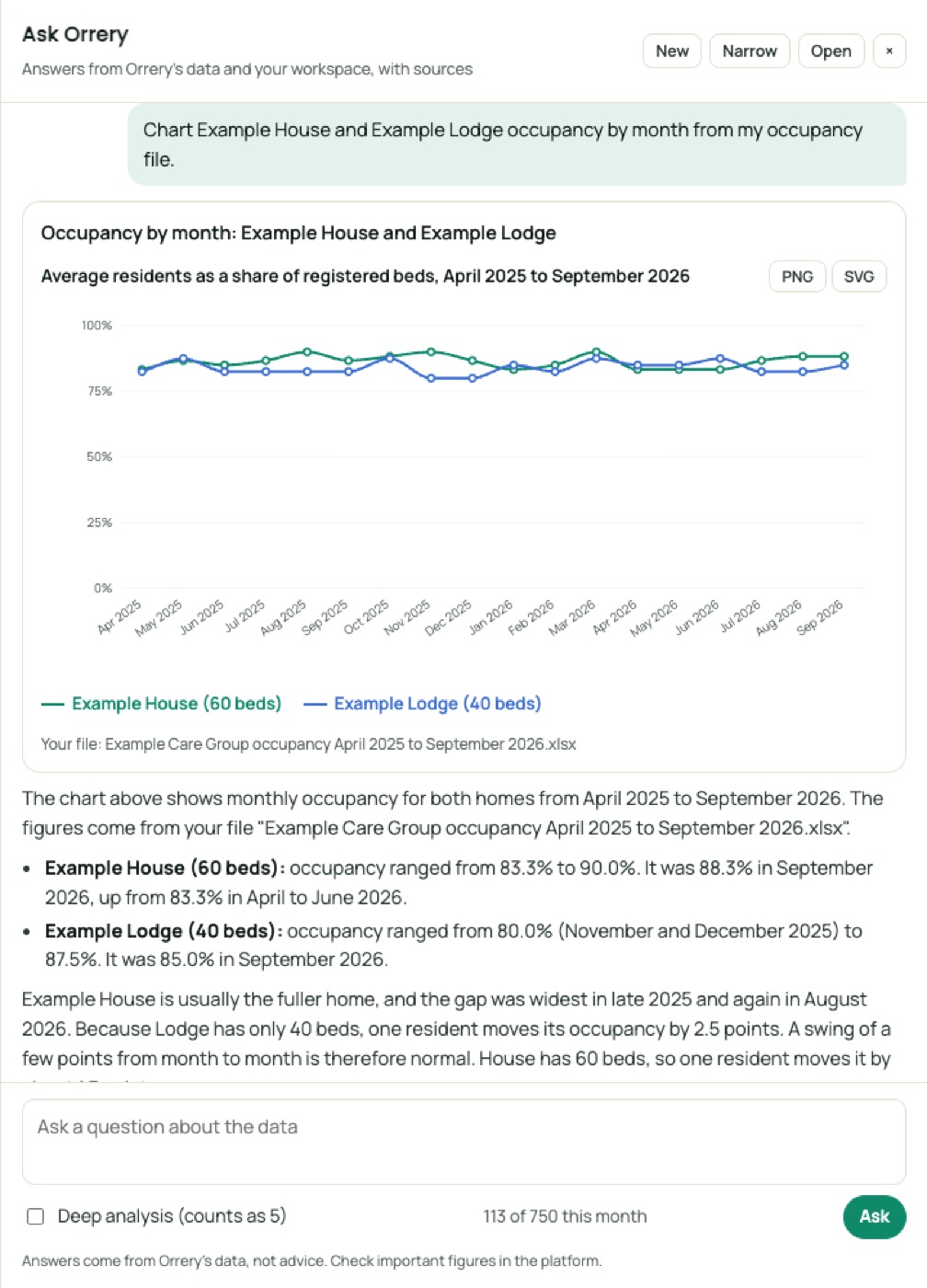
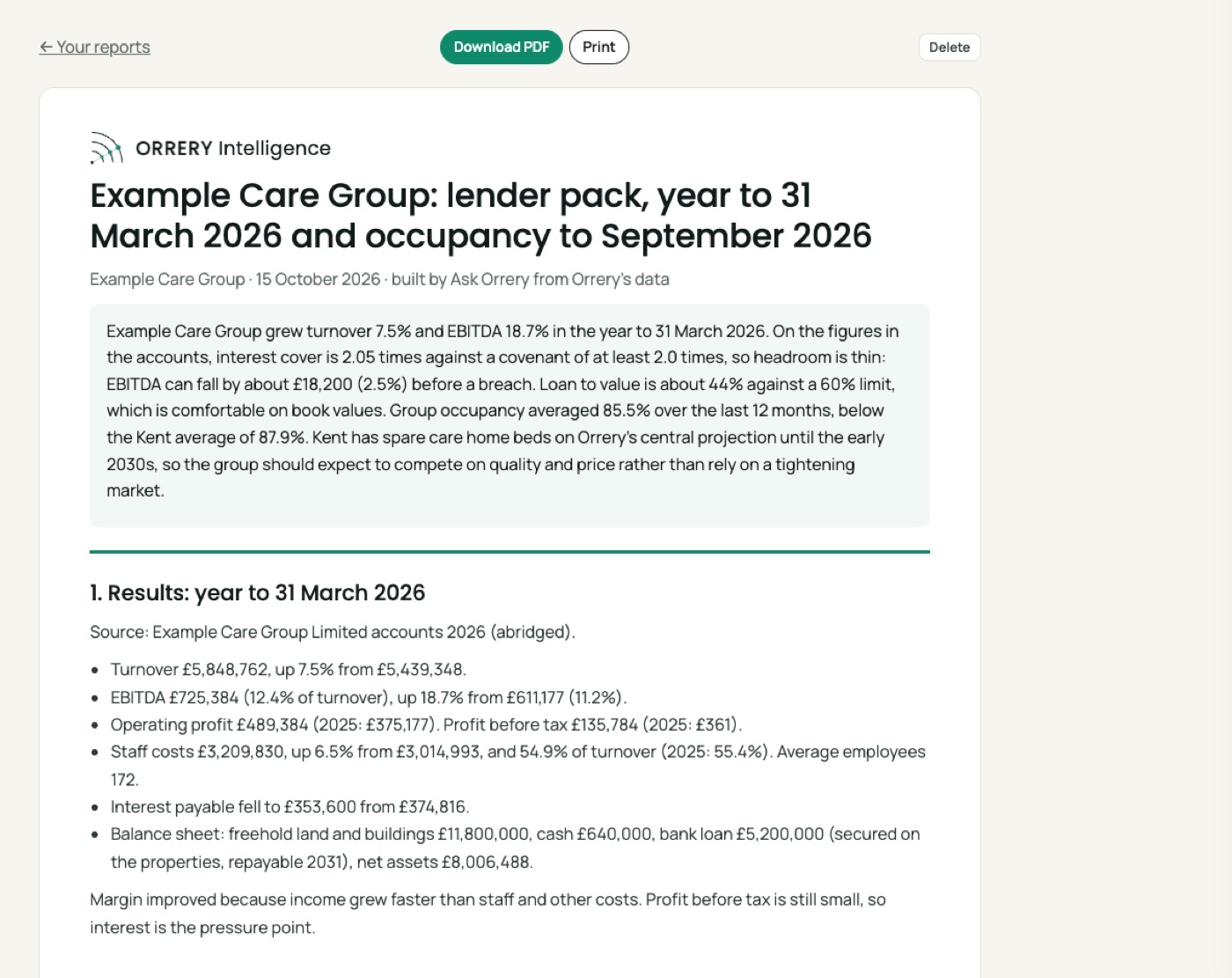
- “Build a two page lender pack: our results and covenants, occupancy, and the Kent market for the next five years.”
Ask the data in plain English
A real question and answer from Ask Orrery, the assistant inside the platform, using the Example Care Group sample files above (October 2026). It works from your files and Orrery's data, and shows its sources.
Interest cover is about 2.05 times, so you pass the 2.0 times covenant, but only just. EBITDA can fall by about £18,200 (2.5%) before you breach it.
Source: your document "Example Care Group accounts 2026.pdf", year ended 31 March 2026.
- EBITDA is £725,384. This is operating profit of £489,384 plus depreciation of £236,000.
- Interest payable is £353,600.
- Interest cover is £725,384 ÷ £353,600 = 2.05 times.
- At 2.0 times, the minimum EBITDA you need is £707,200 (2 × £353,600).
- The headroom is £725,384 − £707,200 = £18,184. That is 2.5% of EBITDA.
Interest is the other lever. Holding EBITDA steady, interest could rise to £362,692 before you breach. That is only £9,092 (2.6%) more than now.
What this means:
- £18,184 is small against turnover of £5,848,762. It is roughly 0.3% of turnover.
- The 2025 accounts show EBITDA of £611,177 and interest of £374,816. That is 1.63 times, below 2.0. Check how and when the covenant is tested, and whether any waiver applied.
- I worked this out from the abridged accounts. Your facility agreement may define EBITDA, finance costs and the test period differently. For example, it may use a rolling 12 months or make adjustments. Check the definitions with your lender or adviser.
I can test this against your monthly profit and loss files for Example House and Example Lodge. I could also model a wage or occupancy shock on EBITDA. This is analysis, not financial advice.
Ask, chart and report, in plain English
Ask Orrery answers from Orrery's data and your own files, draws charts on request and builds reports you can save as PDF. These are real examples made with the sample files.
- Lenders test the downside; show it before they do.
Answer this with your own files
Subscribers get every guide, chart and projection for all 153 councils, Ask Orrery with private uploads of their own files, and every council report.
The Orrery platform opens to subscribers shortly. Register and we will tell you first.
Register for early access