What next April's pay rise costs, person by person
If every hourly rate moves to keep pace with the National Living Wage next April, what does it add to our pay bill, including employer National Insurance and pension?
Upload a recent payroll. Ask Orrery lifts each rate to at least the new legal minimum for the person's age band, keeps or restores your pay steps if you ask, and adds employer National Insurance and pension to give the full yearly cost.
When people use it: From November, once the April rate is announced, and again when budgets are set.
How it works, step by step
Upload the payroll
One normal month is enough. Ask Orrery scales it to a year and says how.
Ask for the cost of the rise
Ask for the low and high ends of the expected April 2027 range: the gap between them is your budget uncertainty until the rate is confirmed.
The national picture
What the rise adds to a typical home's cost per resident a day in your council, to compare with your own.
Cover it with fees
Turn the extra cost into the fee rise you need per resident a week.
What you upload
- A recent month's payroll with each person's hourly rate, hours and age band (or date of birth)
Files are stored privately for your account, never shared with anyone and never used to train AI. You can delete them at any time. Spreadsheets, CSV, PDF and Word files all work, in your own layout.
Try it with sample files
Made up files for a made up provider, Example Care Group, so you can see what Ask Orrery does with them.
Questions you can ask
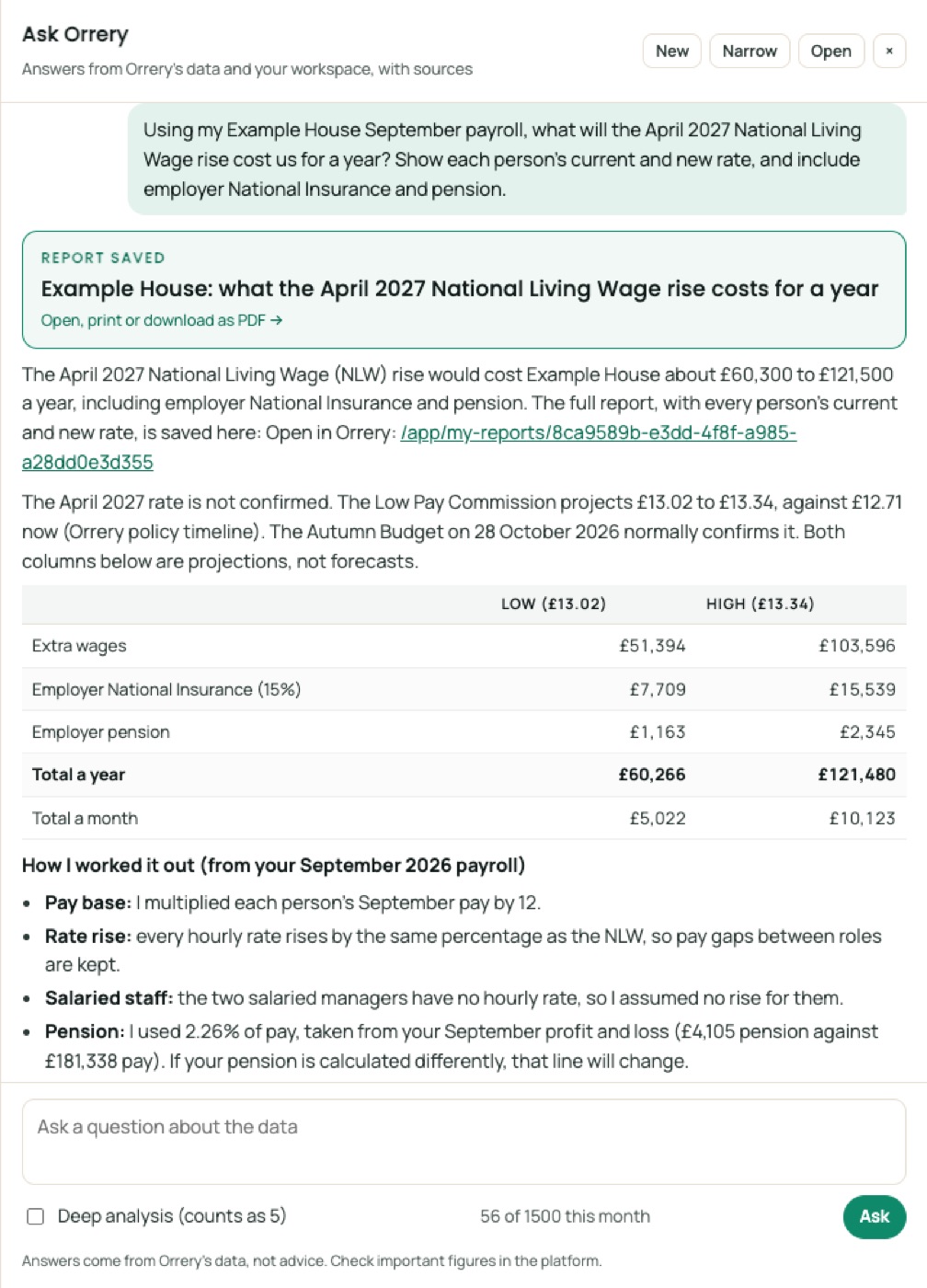
- “Using my Example House September payroll, what will the April 2027 National Living Wage rise cost us for a year? Show each person's current and new rate, and include employer National Insurance and pension.”
- “Do the same if we also keep senior carers 5% above carers and nurses where they are now plus the same percentage rise.”
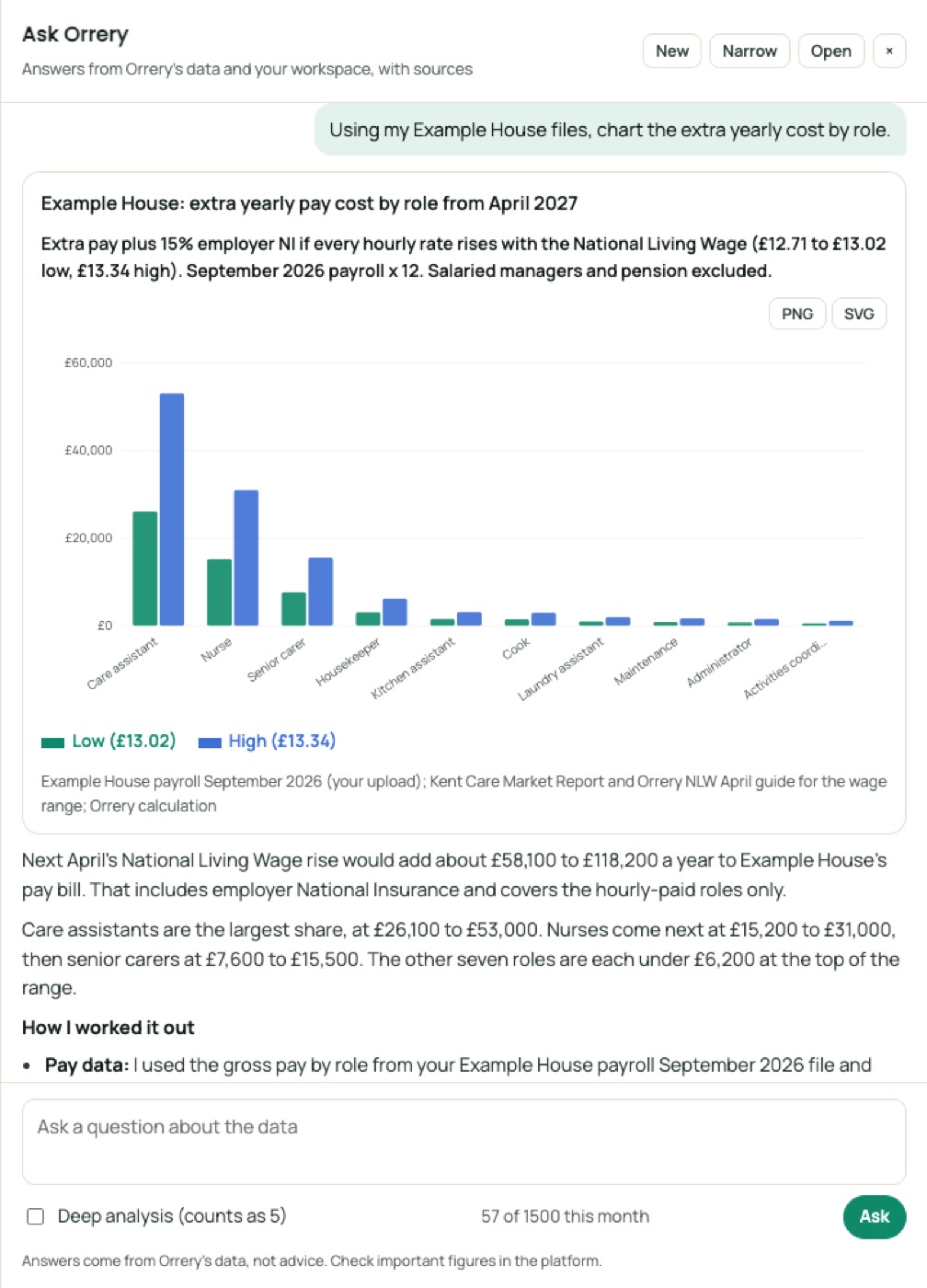
- “Chart the extra yearly cost by role.”
Ask the data in plain English
A real question and answer from Ask Orrery, the assistant inside the platform, using the Example Care Group sample files above (October 2026). It works from your files and Orrery's data, and shows its sources.
The April 2027 rise costs Example House about £90,900 a year at the central rate of £13.18 an hour. That includes employer National Insurance and pension. It is a projection on stated assumptions, not a forecast.
The Low Pay Commission projects £13.02 to £13.34 (Orrery policy timeline). The rate is due to be confirmed at the Budget on 28 October 2026. The current rate is £12.71.
| Case | New rate | Total a year |
|---|---|---|
| Low | £13.02 | £60,300 |
| Central | £13.18 | £90,900 |
| High | £13.34 | £121,500 |
At the central rate, the £90,900 is about £77,500 extra pay, £11,600 employer National Insurance and £1,800 employer pension.
Assumptions (from your September 2026 payroll):
- Every hourly rate rises by the same percentage as the National Living Wage, so pay steps are kept.
- September is scaled to 12 months.
- Employer National Insurance is 15% of the extra pay.
- Pension is 2.26% of the extra pay. I worked that out from your September profit and loss, not from a scheme document. Change it if your scheme rate differs.
- The two salaried managers, agency staff and sick pay are excluded. If the salaried pair also rose by the same percentage, add about £4,800 a year at the central rate.
Check Sam Vaughan. He is paid £12.40 an hour, below the £12.71 rate for other staff aged 21 and over. His payroll note says he turned 21 in June 2026. I moved him to the new floor, which is why his cost is higher than a straight percentage rise. Please check this with your payroll provider or adviser.
What I could not finish:
- The April 2027 rate for under 21s is not in Orrery's data. I scaled the two 18 to 20 staff by the same percentage, which is an assumption.
- The person-by-person table shows the central case only. For low or high figures per person, ask me for "the low case by person".
Guide: /app/guides/pay-rise-cost?council=kent
Ask, chart and report, in plain English
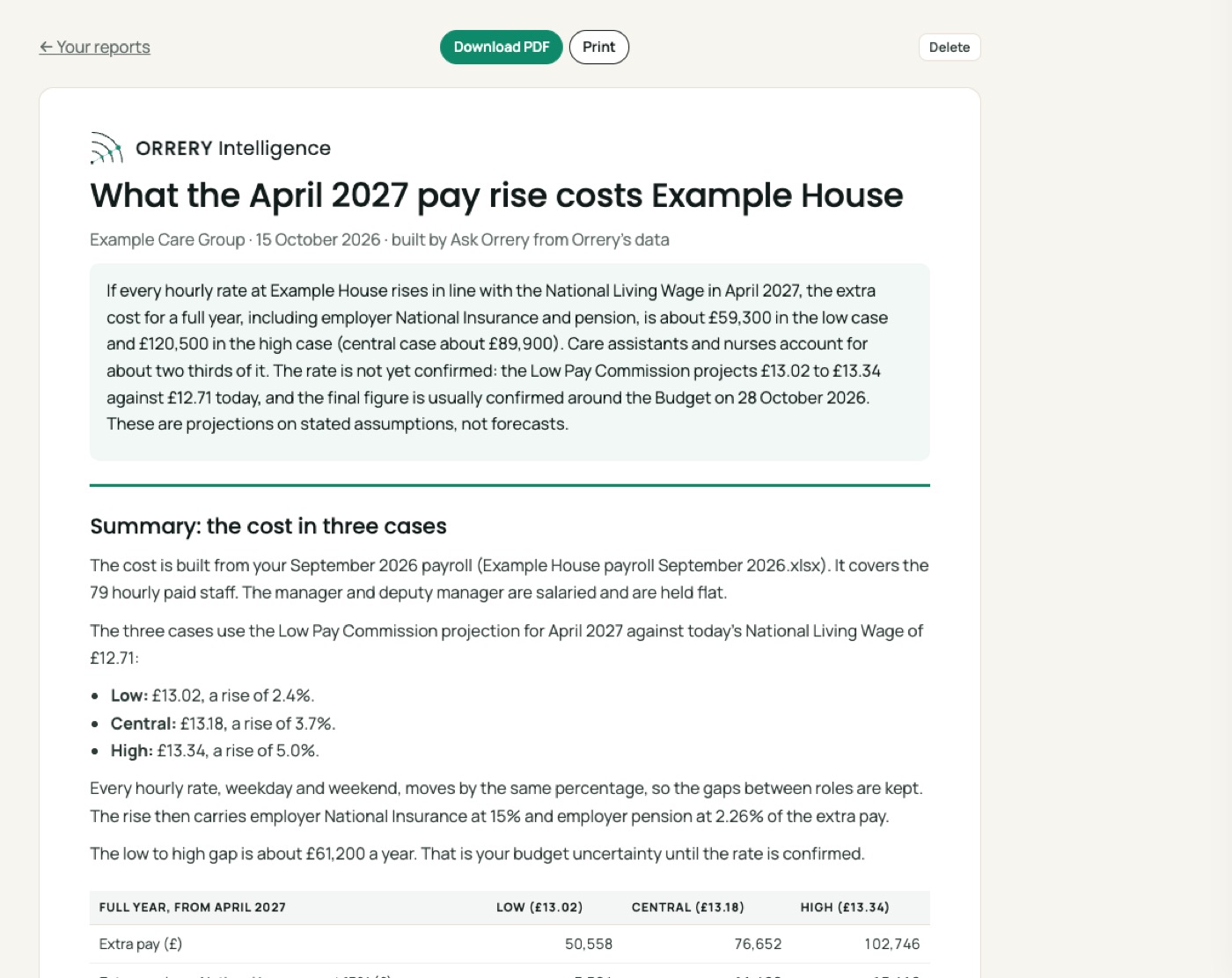
Ask Orrery answers from Orrery's data and your own files, draws charts on request and builds reports you can save as PDF. These are real examples made with the sample files.
- Employer National Insurance is 15% of pay above £5,000 a year per person, so the rise costs more than the rate change alone.
- Staff paid just above the minimum often expect their gap to be kept: costing the rise without it understates the real bill.
Answer this with your own files
Subscribers get every guide, chart and projection for all 153 councils, Ask Orrery with private uploads of their own files, and every council report.
The Orrery platform opens to subscribers shortly. Register and we will tell you first.
Register for early access